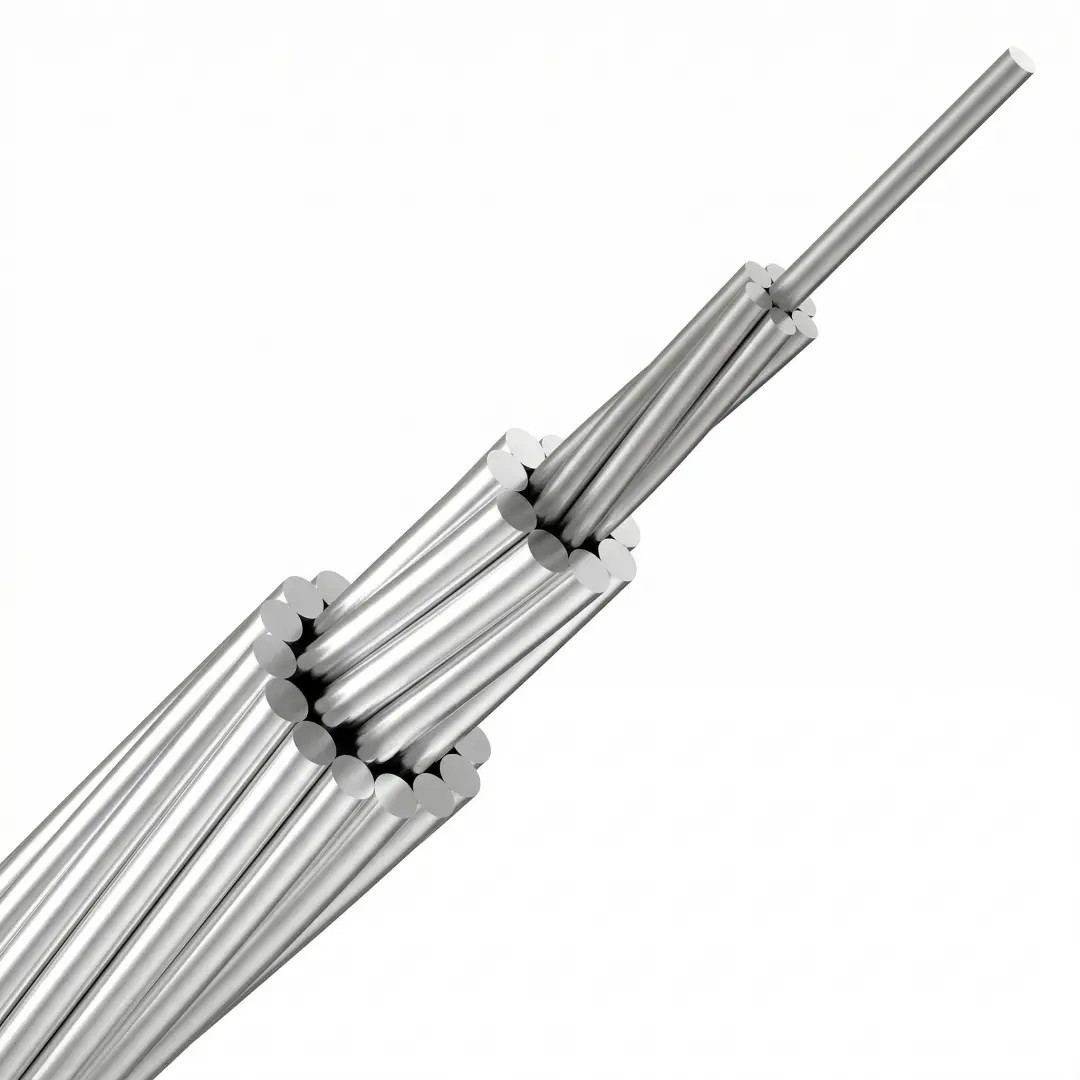
Aluminum Conductor Steel Reinforced
ACSR is a concentrically stranded bare overhead conductor made of hard-drawn EC grade aluminum wires around a galvanized steel core. It is designed for transmission and distribution lines where higher mechanical strength, longer span capability, and improved sag performance are required.
Product Overview
ACSR (Aluminum Conductor Steel Reinforced) is widely used for overhead transmission and distribution lines because it combines the conductivity and light weight of aluminum with the tensile strength of a steel core. By adjusting the aluminum-to-steel ratio, ACSR can be selected for a wide range of span lengths, loading conditions, and environmental requirements. It is one of the most established bare conductor solutions for utility networks, long-span crossings, and mechanically demanding overhead projects.
- Primary and secondary overhead transmission and distribution lines
- Long-span, river-crossing, valley-crossing, and heavily loaded overhead line sections
- Utility lines requiring higher tensile strength and controlled sag performance
- Lines exposed to wind, ice, or demanding mechanical loading
- Projects requiring a proven balance of conductivity, strength, and economy
- IEC 61089
- GB/T 1179
- ASTM B232/B232M
- BS EN 50182 (United Kingdom sizes)
- BS EN 50182 (German sizes)
- DIN 48204
- BS 215-2
Other recognized project-specific standards and corrosion-protection options can be discussed after technical confirmation.
ACSR is a concentric-lay stranded bare conductor consisting of one or more layers of hard-drawn aluminum wires stranded over a galvanized steel core. The steel core may be a single wire or a stranded steel core depending on conductor size and required strength. The conductor can be supplied with Class A, B, or C galvanizing, and additional corrosion protection such as greased core or full conductor greasing can be discussed when required.
- High tensile strength for long-span and mechanically demanding overhead lines
- Better sag control than AAC in equivalent service conditions
- Wide range of aluminum-to-steel ratios for electrical and mechanical optimization
- Proven solution for transmission, distribution, and messenger applications
- Available according to international and project-based standards
- Optional corrosion-protection treatments available on request
Why Choose ACSR
Choose ACSR when the project requires a conductor with higher tensile strength than AAC or AAAC, especially for long spans, challenging terrain, or heavy mechanical loading. The steel core provides reinforcement that allows the conductor to carry higher mechanical loads while the aluminum layers maintain good electrical conductivity for efficient overhead line performance.
ACSR vs AAC / AAAC
- AAC is suitable where conductivity and simplicity are prioritized and mechanical demand is relatively low.
- AAAC offers a homogeneous alloy construction with good corrosion resistance and stronger performance than AAC, but it does not usually match the tensile strength of ACSR.
- ACSR is typically selected when span length, mechanical loading, or structural strength is the key design driver.
- ACSR is often the preferred choice for transmission lines, difficult terrain, and applications where strength and sag control are more critical than a fully homogeneous conductor.
Use the following condensed table on the product page. The full standard-based tables appear in the PDF datasheet.
| Code / Standard | Al / Steel Area (mm²) |
Stranding (Al/St) |
Overall Diameter (mm) |
Unit Weight (kg/km) |
Rated Strength (kN) |
DC Resistance at 20°C (Ω/km) |
| Dog / IEC 61089 | 100/16 | 6/1 | 13.5 | 395.7 | 23.4 | 0.2826 |
| JL/G1A-240/30 / GB/T 1179 | 240/30 | 26/7 | 21.6 | 882.7 | 52.5 | 0.1178 |
| Hawk / ASTM B232 | 241.7/111.0 | 26/7 | 21.79 | 976.1 | 86.7 | 0.1168 |
| Panther / BS EN 50182 | 200/50 | 30/7 | 21.2 | 930.6 | 54.5 | 0.1413 |
| Zebra / BS 215-2 | 400/50 | 54/7 | 28.6 | 1470.2 | 87.5 | 0.0707 |
Q: What is ACSR conductor used for?
A: ACSR is mainly used for overhead transmission and distribution lines, especially where higher tensile strength, longer spans, or more demanding mechanical conditions must be handled.
Q: What is the difference between ACSR and AAC?
A: AAC is an all-aluminum conductor without steel core. ACSR includes a steel core, so it provides much higher tensile strength and improved sag performance for mechanically demanding line design.
Q: What is the difference between ACSR and AAAC?
A: AAAC is a homogeneous aluminum alloy conductor without steel core. ACSR generally offers higher tensile strength, while AAAC may provide a better corrosion profile in some environments.
Q: Why is steel used in ACSR?
A: The steel core provides reinforcement, allowing the conductor to achieve higher mechanical strength and support longer spans without excessive sag.
Q: Which standards are commonly used for ACSR?
A: Common production routes include IEC 61089, ASTM B232/B232M, BS EN 50182, BS 215-2, DIN 48204, and GB/T 1179.
Q: Can Farwalk Cable provide corrosion-protected or project-based ACSR specifications?
A: Yes. Standard-based production, technical confirmation, galvanizing options, and project-specific corrosion-protection arrangements can be provided on request.
Global Engineering & Project Support
Our technical team is ready to discuss customized cable solutions, compliance documentation, and optimized supply chain strategies for your international projects.
REQUEST A QUOTE